Showing posts with label Teach. Show all posts
Showing posts with label Teach. Show all posts
Monday, September 25, 2017

Wednesday, December 28, 2016
NEST: always the right choice?
https://www.britishcouncil.org/voices-magazine/native-english-speaking-teachers-always-right-choice?utm_content=bufferf9d00&utm_medium=social&utm_source=facebook.com&utm_campaign=buffer
Sunday, May 1, 2016
TEFL: Reading Approach
A Teaching Method: Reading Approach | novaekasari09
What Is the Basal Reading Approach? - education.seattlepi.com
? The "Reading Approach" and "The New Method System" (Michael West, The Modern Language Journal, Vol. 22, No. 3 (Dec., 1937), pp. 220-222) - jstor.org
SQ3R Reading Method:
What Is the Basal Reading Approach? - education.seattlepi.com
? The "Reading Approach" and "The New Method System" (Michael West, The Modern Language Journal, Vol. 22, No. 3 (Dec., 1937), pp. 220-222) - jstor.org
SQ3R Reading Method:
New English Language Teaching Methods | The Principled Eclecticism Approach
The Way Ahead
The respected author and American university professor, Douglas Brown, provides a list of the ‘ten commandments’ for effective language learning, applied to both ESL teachers and learners:
From his book Principles of Language Learning & Teaching (Pearson Longman, 2001)
For EFL Teachers For Language Learners Lower inhibitions Fear not! Encourage risk-taking Dive in Build self-confidence Believe in yourself Develop intrinsic motivation Seize the day Engage in cooperative learning Work with your team Use right-brain processes Get the BIG picture Promote ambiguity tolerance Cope with the chaos Practice intuition Follow your hunches Process error feedback Make mistakes work FOR you Set personal goals Set your own goals
These recommendations aim to promote learner autonomy and stress the importance of self-motivation.
!!! All main TEFL methods/approaches
teaching-methods-timeline-large.png (2500×1250)
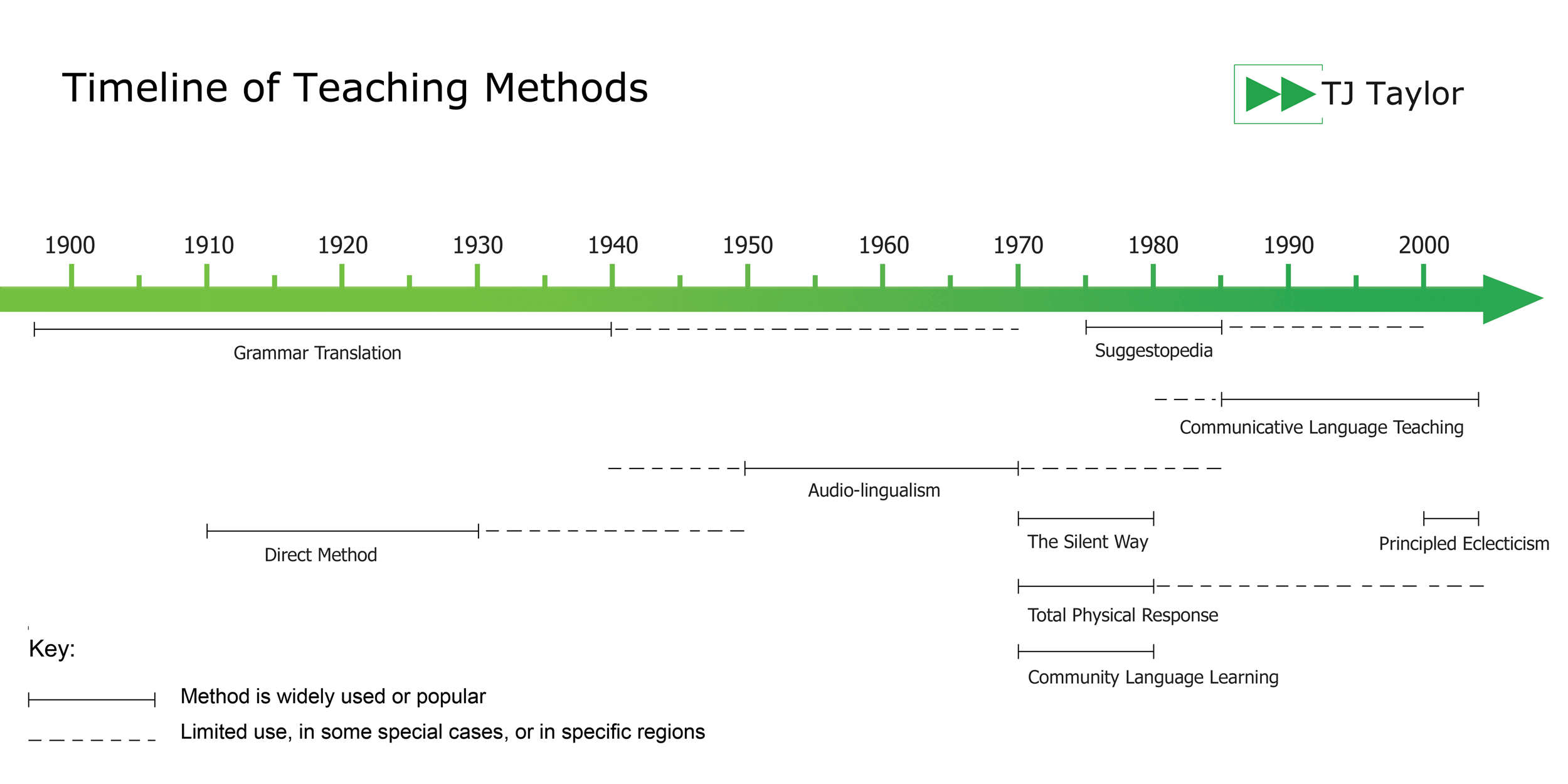
Second and Foreign Language Teaching Methods - moramodules.com
Theoretical Orientations to L2 Methods & Approaches
There are four general orientations among modern second-language methods and approaches:
1. STRUCTURAL/LINGUISTIC: Based on beliefs about the structure of language and descriptive or contrastive linguistics. Involves isolation of grammatical and syntactic elements of L2 taught either deductively or inductively in a predetermined sequence. Often involves much meta-linguistic content or "learning about the language" in order to learn the language.
2. COGNITIVE: Based on theories of learning applied specifically to second language learning. Focus is on the learning strategies that are compatible with the learners own style. L2 content is selected according to concepts and techniques that facilitate generalizations about the language, memorization and "competence" leading to "performance".
3. AFFECTIVE/INTERPERSONAL: Focuses on the psychological and affective pre-dispositions of the learner that enhance or inhibit learning. Emphasizes interaction among and between teacher and students and the atmosphere of the learning situation as well as students' motivation for learning. Based on concepts adapted from counseling and social psychology.
4. FUNCTIONAL/COMMUNICATIVE: Based on theories of language acquisition, often referred to as the "natural" approach, and on the use of language for communication. Encompasses multiple aspects of the communicative act, with language structures selected according to their utility in achieving a communicative purpose. Instruction is concerned with the input students receive, comprehension of the "message" of language and student involvement at the students' level of competence.
Tuesday, April 26, 2016
Friday, April 8, 2016
Friday, February 19, 2016
Monday, December 28, 2015
Monday, November 16, 2015
Българските змейове, обсадили върховете на световната анимация / Първият трейлър излиза на 16 ноември < offnews.bg
Българските змейове, обсадили върховете на световната анимация / Първият трейлър излиза на 16 ноември < offnews.bg
Димитър: „Ghibli” точно затова са готини, защото те имат тези елементи, има го социалния коментар, но не третират анимацията като нещо, насочено към деца. Те правят приказки, които могат да се гледат от възрастни и от деца. „Принцеса Мононоке” е най-добрият пример, филм, който като малък много гледах и ми е повлиял. Според мен анимацията е точно това, което те правят – много приказни и интересни истории, които засягат и съвременни сюжети.
Ели: Много е ключово, че анимацията там не се възприема като жанр. Анимацията е метод, а жанрът може да е комедия, приключение, драма. Тя може да е за деца и за възрастни.
Димитър:... А и съвременният комикс се счита за наследство на плакатите, които се появяват през ПСВ. Но всичко е оплетено по един невероятен начин и това, че хората мислят, че анимацията е насочена към децата, понякога играе добра роля, защото така се вмъкват разни неща, които иначе не биха могли да бъдат разказани.
Sunday, November 15, 2015
Tuesday, November 3, 2015
Wednesday, September 9, 2015
Saturday, September 5, 2015
Subscribe to:
Posts (Atom)