Showing posts with label method. Show all posts

Sunday, May 1, 2016

TEFL: Reading Approach

A Teaching Method: Reading Approach | novaekasari09

What Is the Basal Reading Approach? - education.seattlepi.com

? The "Reading Approach" and "The New Method System" (Michael West, The Modern Language Journal, Vol. 22, No. 3 (Dec., 1937), pp. 220-222) - jstor.org

SQ3R Reading Method:

New English Language Teaching Methods | The Principled Eclecticism Approach


The Way Ahead

The respected author and American university professor, Douglas Brown, provides a list of the ‘ten commandments’ for effective language learning, applied to both ESL teachers and learners:
For EFL TeachersFor Language Learners
Lower inhibitionsFear not!
Encourage risk-takingDive in
Build self-confidenceBelieve in yourself
Develop intrinsic motivationSeize the day
Engage in cooperative learningWork with your team
Use right-brain processesGet the BIG picture
Promote ambiguity toleranceCope with the chaos
Practice intuitionFollow your hunches
Process error feedbackMake mistakes work FOR you
Set personal goalsSet your own goals
From his book Principles of Language Learning & Teaching (Pearson Longman, 2001)
These recommendations aim to promote learner autonomy and stress the importance of self-motivation. 

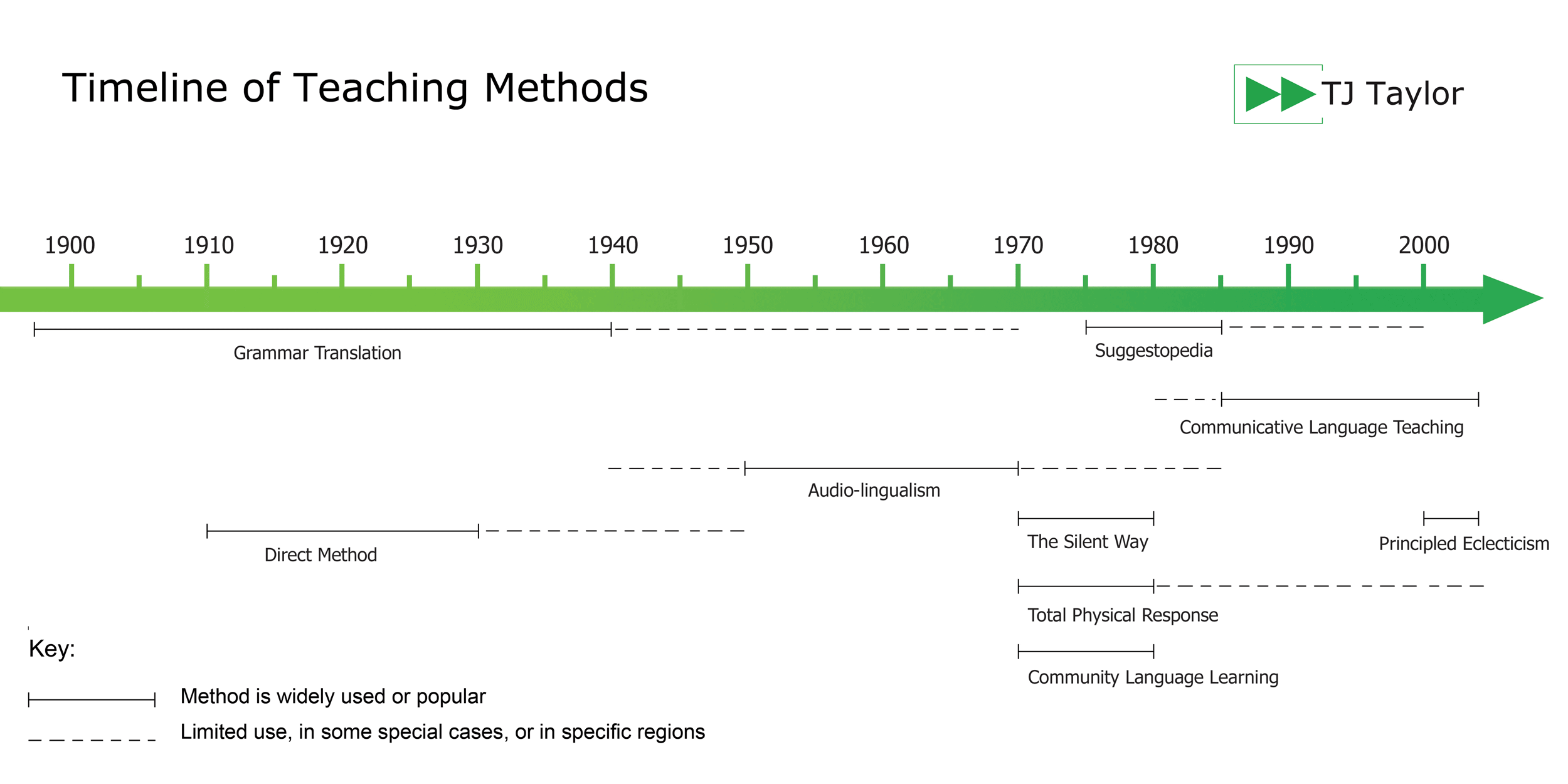
!!! All main TEFL methods/approaches

teaching-methods-timeline-large.png (2500×1250)

Second and Foreign Language Teaching Methods - moramodules.com

Theoretical Orientations to L2 Methods & Approaches

There are four general orientations among modern second-language methods and approaches:

1. STRUCTURAL/LINGUISTIC: Based on beliefs about the structure of language and descriptive or contrastive linguistics. Involves isolation of grammatical and syntactic elements of L2 taught either deductively or inductively in a predetermined sequence. Often involves much meta-linguistic content or "learning about the language" in order to learn the language.

2. COGNITIVE: Based on theories of learning applied specifically to second language learning. Focus is on the learning strategies that are compatible with the learners own style. L2 content is selected according to concepts and techniques that facilitate generalizations about the language, memorization and "competence" leading to "performance".

3. AFFECTIVE/INTERPERSONAL: Focuses on the psychological and affective pre-dispositions of the learner that enhance or inhibit learning. Emphasizes interaction among and between teacher and students and the atmosphere of the learning situation as well as students' motivation for learning. Based on concepts adapted from counseling and social psychology.

4. FUNCTIONAL/COMMUNICATIVE: Based on theories of language acquisition, often referred to as the "natural" approach, and on the use of language for communication. Encompasses multiple aspects of the communicative act, with language structures selected according to their utility in achieving a communicative purpose. Instruction is concerned with the input students receive, comprehension of the "message" of language and student involvement at the students' level of competence.

The Audio-lingual Method | English Language Teaching Methodologies

The audiolingual method - slideshare.net

Monday, November 16, 2015

Българските змейове, обсадили върховете на световната анимация / Първият трейлър излиза на 16 ноември < offnews.bg

Димитър: „Ghibli” точно затова са готини, защото те имат тези елементи, има го социалния коментар, но не третират анимацията като нещо, насочено към деца. Те правят приказки, които могат да се гледат от възрастни и от деца. „Принцеса Мононоке” е най-добрият пример, филм, който като малък много гледах и ми е повлиял. Според мен анимацията е точно това, което те правят – много приказни и интересни истории, които засягат и съвременни сюжети.

Ели: Много е ключово, че анимацията там не се възприема като жанр. Анимацията е метод, а жанрът може да е комедия, приключение, драма. Тя може да е за деца и за възрастни.

Димитър:... А и съвременният комикс се счита за наследство на плакатите, които се появяват през ПСВ. Но всичко е оплетено по един невероятен начин и това, че хората мислят, че анимацията е насочена към децата, понякога играе добра роля, защото така се вмъкват разни неща, които иначе не биха могли да бъдат разказани.

Thursday, February 12, 2015

PAPERLESS: Do You Provide Content For Students or Draw It From Them?

[PAPERLESS:] Do You Provide Content For Students or Draw It From Them?
... socially-constructed knowledge as opposed to paper-led facts.
... emergent intelligence & linguistic awareness as opposed to expense, bored scribbles and static scripts.
... emotional/social intelligence, self-expression and the story of language.
... everyday interaction as opposed to gluts of paper blocking the flow of humanistic linguistics.
...
3) What are the pedagogical reasons for running a paperless classroom?The advantage is primarily that it switches the focus of the course from providing content for the students to drawing the content from them. Classes became primarily about the students talking about their experiences and interests.
...

5) What was the most fundamental insight you gained?Consistency of approach is the most powerful tool in education. No one activity, no matter how engaging, will lead to learning. It is the consistent implementation of an approach in all classes and by all teachers that makes a progamme successful.